NCR Atleos Launches AllTM: Should Your Store Add an ATM?
NCR Atleos launched AllTM on Nov. 5. Learn when an ATM for a retail store pays off, how surcharge splits work, and what to ask before you sign.
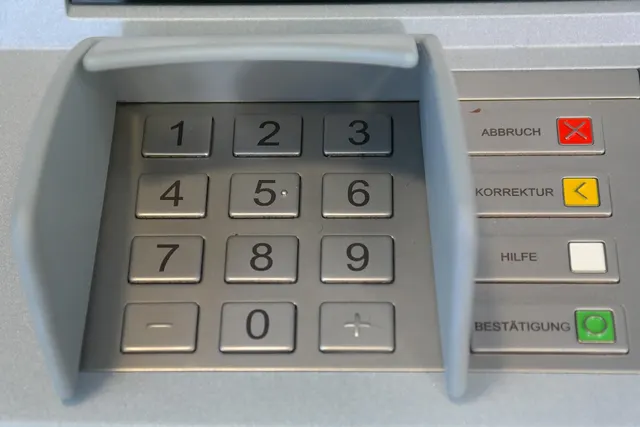
Photo: Pixabay
On this page 6 sections
Key takeaways
- AllTM packages Atleos's managed retail ATM services into one program. Pricing and revenue-share terms aren't public, so you'll only learn them from a quote.
- In our illustrative math, a leased, self-loaded machine beats a managed placement only above roughly 113 surcharged withdrawals a month. Your own crossover depends on the terms you're quoted, and that's before you count cash risk.
- Atleos's own figures say ATM users spend more in the store. What matters for you is how many visits the machine adds that you wouldn't get anyway.
- Before signing, find out who is the legal "ATM operator" under Regulation E and who is responsible for ADA compliance.
NCR Atleos announced AllTM on Nov. 5, 2026. It's a managed ATM program for U.S. retailers that puts cash withdrawals, deposits, bill payment and cardless transactions into one small-footprint machine. Whether an ATM for a retail store pays off comes down to three numbers: how many surcharged withdrawals you'll get each month, how much of each fee you keep, and what it costs to hold and load the cash. If your customers already ask whether you have an ATM, as they often do at liquor stores, tobacco shops and neighborhood grocers, a managed machine with clean contract terms can be an easy addition. If most of your sales already go on cards, there isn't much to gain.
What NCR Atleos Announced on Nov. 5
Atleos announced AllTM in an Atlanta press release dated Nov. 5, 2026. The company says the program is built for everyone from single-store operators to large national chains. Besides cash withdrawals, the machine handles consumer deposits, store deposits, bill payment and cardless transactions.
The AllTM product page says Atleos fully manages the machine, including cash replenishment, monitoring, maintenance and compliance. The unit pictured is the NCR SelfServ 62, a cash-recycling ATM. Listed security options include UL 437 locks, CEN I and CEN IV GasEx certified safes (GasEx ratings cover gas-explosion attacks), cameras, anti-skimming hardware and alarms.
The Paypers notes that AllTM bundles services Atleos has offered retailers for several years. So the package is new, but the kind of machine isn't. Neither the release nor the product page we reviewed lists pricing or revenue-share terms, so the only way to find out what a store earns is to ask for a quote. AllTM isn't Atleos's only retail move this fall, either. Its newsroom lists an Oct. 19, 2026 announcement that First Citizens Bank will work with Atleos to provide ATM access at Target stores nationwide.
Why Retailers Are Rethinking In-Store ATMs
Atleos is pitching foot traffic as much as fee income. The release says the machine can take labor and cash-handling work off over-the-counter financial services. Those are the bill-pay and money-service counters that tie up a cashier in many grocery and convenience stores. A customer paying a utility bill at the ATM isn't holding up the register line.
The AllTM page also makes two marketing claims: ATM users spend 20% more in-store than non-users, and more than half of ATM users buy something at the same location. These are Atleos's own figures, not an independent study. They also measure people who were already in the store. Someone who withdraws $60 and then buys a six-pack might have bought the six-pack with a card anyway. What you need to estimate is how many visits the machine adds that you wouldn't otherwise get, because only those visits bring in new revenue.
For some owners, store deposits may matter more than the marketing numbers. If you can deposit the day's cash into the machine instead of driving it to the bank, you save a trip and keep less cash in the back office. Before you count on that, ask which bank receives the deposit, when it's credited and who carries the risk until then. Compare the answers with your current cash handling procedures for safe drops and deposits.
Who Benefits Most From an ATM for a Retail Store
Cash-heavy storefronts with frequent, small purchases get the most out of an ATM.
Liquor stores do much of their business on Friday evenings, weekends and the days before holidays, and they stay open after nearby bank branches close. If a customer walks in without cash and finds an ATM near the cooler, you keep the sale. A store that encourages cash payment may see more ATM use. The cash discount math later in this article shows how the surcharge can work against that, though. For card-side setups, see our payment options for liquor stores.
Tobacco, vape and nicotine shops serve regulars who come in often for small, quick purchases, and many of those regulars prefer cash. Some of these shops also lose a card processor because the category is classed as high-risk. An ATM keeps cash buyers coming in, but it doesn't replace card acceptance, and most customers will still expect to tap. If you've lost a processor, start with a high-risk merchant account and treat the ATM as an add-on. Laws on age-restricted products vary by state, and an ATM on the floor doesn't change your ID-check duties. Our tobacco and cigarette payment processing page covers the card side.
Grocery markets are the most natural fit for AllTM's extra features. Neighborhood markets often already handle bill payments, money orders or remittances at the counter, and moving some of that work to a self-service machine frees up staff. If your market already offers money transfers, our guide to adding remittance services to your store covers the compliance side. The grocery market payments page covers checkout.
The weak fits are stores with large average tickets that are already mostly on cards, stores where the only open spot is out of the cashier's sight, and stores where nobody has asked for an ATM in months.
One red flag: be careful with any provider offering a so-called "cashless ATM" that records a retail purchase as an ATM withdrawal at your register. A terminal that misdescribes what the customer actually bought creates network-rule risk and possible legal risk for your merchant account. Talk to your processor and an attorney before agreeing to anything like that.
Revenue Models: Surcharge Splits, Leases and Owned Machines
Most in-store ATM deals follow one of three models. Terms vary by provider, so the table shows how each model is structured, not what it pays.
| Model | Who owns the machine | Who loads cash | What you earn | Your risk |
|---|---|---|---|---|
| Managed placement (AllTM's model) | Provider | Provider | A share of each surcharge, or a set fee | Low; mostly floor space and contract terms |
| Leased, self-loaded | Provider or leasing company | You | Most of the surcharge, minus processing and lease payments | Cash on hand, loading labor, lease term |
| Owned, self-loaded | You | You | The surcharge, minus processing and service costs | All of the above, plus hardware and repair costs |
ATM operators may also earn network fees on each transaction. That income depends on network rules that are in litigation right now. We cover the case in ATM operators appeal the Visa-Mastercard fee case.
When Does a Self-Loaded Machine Beat a Managed Placement?
Every number below is illustrative, not a quote from Atleos or anyone else. Assume a $3.00 surcharge and 300 surcharged withdrawals a month.
- Managed placement: you receive $0.50 per surcharged withdrawal. 300 × $0.50 = $150 a month, with no cash or loading duties.
- Leased, self-loaded: you keep $3.00 minus a $0.50 processing fee, or $2.50 per withdrawal. 300 × $2.50 = $750. Subtract a $120 lease, $25 for wireless and service, and 4 hours of staff loading time at $20 an hour ($80). Monthly costs come to $225, which leaves a net of $525 a month. You also have about $10,000 of your own cash sitting in the machine.
On these assumptions, the leased machine breaks even at 90 withdrawals a month ($225 ÷ $2.50). It starts out-earning the managed placement at about 113 withdrawals a month, which is where $2.50n − $225 equals $0.50n. At 300 withdrawals, the leased, self-loaded machine earns $375 more a month. That $375 is your pay for carrying the cash, taking on the theft risk and doing the loading. Change any input and the crossover moves. If your volume is uncertain, or you can't spare staff for dual-control loading, the managed model is the safer choice.
Store pricing also affects how much the machine gets used. A store running a cash discount program wants customers to pay in cash. In an illustrative case, a customer saves $1.40 by paying cash on a $40 purchase, then pays a $3.00 ATM fee to get that cash. They come out behind, and regulars notice. Dual pricing shows both prices at the shelf, so customers can see that comparison even more easily.
Costs and Duties: Cash Loading, Security and Compliance
Fee disclosure is federal law. Under Regulation E, 12 CFR § 1005.16, an ATM operator that charges a fee must disclose that a fee applies and how much it is. The notice must appear on screen or on paper before the customer is committed to paying, and the operator can charge the fee only if the customer chooses to continue. In a managed deal, the provider is usually the operator. If you own the machine, the duty is likely yours. Either way, the contract should say who holds it.
Accessibility is also law. The 2010 ADA Standards require that where ATMs are provided, at least one at each location meet Section 707. That section covers speech output, privacy of input and output, Braille instructions for starting speech mode, and controls people can reach. Compliant hardware won't help if it sits behind a display rack, so placement matters too.
Loading cash carries the same theft risk as your drawer and safe. Use two people, written logs and spot audits. The controls in how to prevent employee theft in a retail store apply here as well. Ask your insurer whether cash in the machine is covered.
Retail ATM Placement: Visible, Accessible, Away From the Door
Put the machine where cashiers and cameras can see it, away from the exit so a thief doesn't get an easy escape route, and on an accessible path. A spot near impulse items works, as long as it doesn't block an aisle. Check the card reader for skimming devices as part of your opening routine.
State and local rules on ATMs vary. This article is general information, not legal advice, so confirm your obligations with an attorney before installation.
Questions to Ask Any ATM Provider Before You Sign
- What surcharge will the machine charge, who sets it, and can I change it?
- What is my share per surcharged withdrawal, and do I earn anything on deposits, bill payments, balance inquiries or declined transactions?
- How long is the contract, does it renew automatically, and what are the early-termination and removal fees?
- Does the contract stop me from offering any other cash-access service in the store?
- Who is the ATM operator under Regulation E, and who is responsible for ADA compliance?
- How often is cash replenished, and how fast is an outage or cash-out fixed?
- For store deposits, which bank receives the funds, when are they credited, and who is liable until then?
- Who pays for theft, vandalism or damage to the machine?
- What power, network and floor-space requirements does the machine have?
- What happens to the contract if I sell the store or relocate?
Before you call any provider, have cashiers spend two weeks counting every customer who asks for an ATM or leaves because they couldn't pay. That gives you a rough read on demand. Then get at least two written quotes and redo the break-even and crossover math above with each provider's actual surcharge share, processing fees, lease payment and loading costs in place of the illustrative inputs.
If your expected volume is well above your real crossover, self-loading may be worth the cash risk. If it's near or below it, a managed placement, or no machine at all, makes more sense. And if customers keep asking for cash because card fees push you to steer them away from cards, look at what card acceptance costs you. You can request a free quote from MannyPay, and a specialist responds within one business day.
Sources
- NCR Atleos introduces AllTM, an ATM solution designed for retailers (press release, Nov. 5, 2026)
- NCR Atleos Newsroom: AllTM announcement
- AllTM by NCR Atleos (product page)
- NCR Atleos Newsroom (news listing, including Oct. 19, 2026 First Citizens Bank and Target announcement)
- The Paypers: NCR Atleos launches AllTM ATM solution for US retailers
- ATM Marketplace: NCR intros AllTM, a multifunctional retail ATM
- 12 CFR § 1005.16, Disclosures at automated teller machines (Regulation E)
- 2010 ADA Standards for Accessible Design (Sections 220 and 707)
This article is for general educational purposes and is not legal, tax or financial advice. Card network rules and state laws change; confirm current requirements for your business.