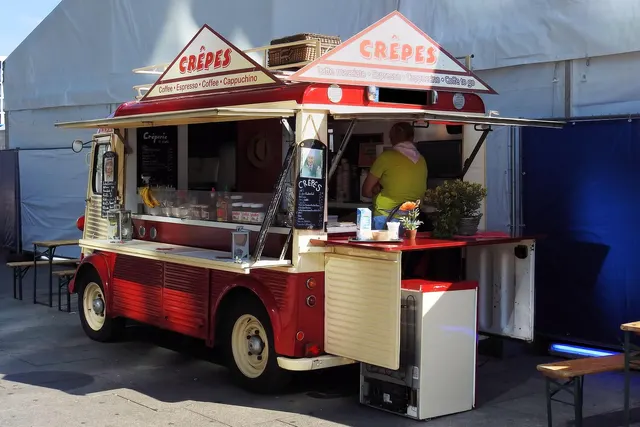
Food Truck Loyalty Programs That Work Without a Fixed Address
Set up a food truck loyalty program that brings regulars back to every stop: compare POS, card-linked and app options, reward costs and texting rules.
Photo: Pixabay
On this page 7 sections
- Why Punch Cards Fall Short When the Truck Moves
- Comparing Food Truck Loyalty Program Options
- Pair Rewards With a "Where We Park Today" Text Club
- Sign Customers up After Payment, Not Before
- What a Reward Really Costs: A Worked Example
- Texting Rules: Consent, Quiet Hours and Opt-Outs
- Start With the Screen You Already Have
Key takeaways
- For most trucks, loyalty built into the POS plus an opt-in weekly schedule text does both jobs: it rewards visits and tells regulars where you're parked.
- In the illustrative model, one member who adds a visit each month pays for about four who don't. With 100 members, breaking even takes 27 members who change their habits.
- A phone number entered for points is not consent for marketing texts. Opt-outs must be honored within 10 business days, however the customer asks.
- Don't send a Sunday-evening schedule text. A 10 a.m. Monday send fits the federal window and the stricter state limits, including Sunday bans in Alabama, Louisiana and Mississippi.
A food truck loyalty program has two jobs. It rewards repeat visits, and it tells your regulars where the truck is parked today. For most trucks, the simplest setup that does both is loyalty built into the POS, where customers type a phone number on the customer-facing screen. Pair it with an opt-in text club that sends the week's schedule. Card-linked rewards suit fast, card-heavy lunch lines. A standalone app only makes sense for trucks with a following big enough that people will download something.
Owners usually get burned in two places: the reward math and the texting laws. Both are covered below, including an illustrative calculation of how many members have to change their habits before a program pays for itself.
Why Punch Cards Fall Short When the Truck Moves
A café's regulars walk past the same door every morning. Yours find you at an office park on Tuesday and a brewery on Friday, and a paper card does nothing to connect those visits. Customers who see you twice a month leave it in a junk drawer. Anyone with a craft-store hole punch can complete one, and you have no way to audit redemptions. The card tells you nothing about who your regulars are or which stops they follow you to, and it can't reach them when your route changes. Stamping it also adds seconds to every order during the noon rush.
A better replacement uses something the customer already brings to the window: a phone number, a payment card or a phone app. Choose based on how much friction your crowd will put up with and whether you want permission to message them.
Comparing Food Truck Loyalty Program Options
| Factor | POS-Built-In | Card-Linked | Standalone App |
|---|---|---|---|
| How customers join | Phone number at checkout | Register a card once | Download an app or add a wallet pass |
| Friction at the window | Low | Lowest after signup | Moderate (scan or lookup) |
| Works with cash | Yes, by phone lookup | No, unless phone lookup is added | Yes |
| Tells regulars where you are | Only with a text club | Not on its own | Sometimes, via map or push alerts |
| Data sits with your sales | Yes | Depends on the vendor | Separate in most setups |
| Best fit | Trucks with steady regulars | Fast lunch lines, card-heavy crowds | Trucks with a strong brand following |
POS-Built-In Loyalty
Many POS platforms offer loyalty natively or through their app marketplace. The customer enters a phone number on the screen. The system logs the visit or the spend and applies the reward automatically once the customer reaches the threshold. Redemptions show up in the same reports as your sales, so if each sale is tagged by stop, you can see which locations your members favor.
Before you turn it on, ask what the add-on costs each month and whether you can export the member list if you change POS providers. A list you can't take with you belongs to the software company. If you're still choosing hardware, our guide to the best food truck POS system for a moving kitchen covers screens, connectivity and battery life.
Card-Linked Rewards
Here the customer registers a payment card once. Every later purchase on that card earns credit with nothing typed and nothing scanned, which makes this the fastest option at the window. Phone wallets are the catch. When someone taps with Apple Pay or Google Pay, the terminal receives a device-specific token instead of the number printed on the plastic card.
Get a clear answer from the vendor on how it matches wallet taps to a registered card, because a program that misses those taps misses every customer who pays with a phone. Also ask whether the vendor stores tokens rather than full card numbers and how its setup affects your PCI DSS obligations. Cash customers are left out entirely, and a registered card gives you no permission to text anyone.
Standalone Rewards Apps
A food truck rewards app gives you your own branding, push notifications and, in some cases, a live map of where you're parked. Its weakness is the download. Someone who eats at your window every other week is unlikely to install an app for it. Most of these apps also run outside the POS, so staff have to scan a code or key in rewards by hand. That adds steps and creates room for errors. Choose this route when you already have fans who seek you out, not as a way to build that following.
Pair Rewards With a "Where We Park Today" Text Club
For a truck, the most valuable perk is information. Regulars who love your birria can't buy it if they don't know you're two blocks away, and points don't fix that. Food truck customer text alerts do.
Keep the cadence low. Send one schedule text on Monday morning listing each day's stop and hours, so customers can plan their week. The texting rules below explain why Monday works better than Sunday night. Save extra messages for real changes like a weather cancellation, a sellout or a last-minute event booking, because daily reminders drive opt-outs. If your platform supports segments, let subscribers pick a neighborhood so the downtown lunch crowd doesn't get alerts about a suburban brewery night. When one stop underperforms, a "double points at Tuesday's stop" text is a cheap test of whether regulars will follow you there.
Put a preorder link in the schedule text too, so regulars can skip the line. Our guide to food truck online ordering and preorders when your location changes walks through setup.
Sign Customers up After Payment, Not Before
Enrollment belongs in the dead time while a customer waits for food. Asking before payment slows everyone behind them.
- Prompt for the phone number on the customer-facing screen right after the tip screen, so the customer enrolls while staff take the next order. Our comparison of countertop vs. wireless vs. mobile card readers shows which form factors put a screen in front of the customer.
- Post a text-to-join keyword and QR code on the menu board and at the pickup counter, so people join while still in line.
- Give staff one sentence to say: "Free side after five visits. Just add your number on the screen."
- Drop the verbal pitch when the line is long and let the signage do the work. The rest of our tips on how to speed up a food truck line at the payment window apply here.
Set the first reward close. A customer who finds you every other week needs four months to reach an eight-visit reward, and most will lose interest long before then. A sit-down restaurant can ask for more patience. Our restaurant loyalty program ideas that bring diners back sooner has reward structures worth adapting. The example below shows what a shorter threshold costs.
What a Reward Really Costs: A Worked Example
A free item costs you its food and packaging, not its menu price. The bigger expense is rewarding regulars who would have come anyway. Here is an illustrative model. Every number is an assumption, so swap in your own.
- A $12 bowl with $3.60 in food and packaging (30% food cost).
- One free bowl for every five paid visits.
- $0.36 in card processing on each $12 sale. That's 3%, a round figure for illustration. Your effective rate depends on your pricing and card mix.
- $50 a month for loyalty software.
- 100 enrolled members, each of whom visited twice a month before launch.
A member who keeps coming twice a month earns 0.4 rewards a month. That costs you $1.44 and brings in nothing new. A member who goes from two visits to three adds a $12 sale worth $8.04 after food and processing. That member earns 0.6 rewards ($2.16), for a net gain of $5.88 a month.
So one member who adds a visit covers about four who don't change. Add in the $50 software fee, and with 100 members you break even when 27 of them add one visit a month. Those 27 members bring in 27 × $5.88 = $158.76. Against that, the 73 unchanged members earn 73 × $1.44 = $105.12 in rewards, plus the $50 fee, for $155.12 in costs. At 26 members who add a visit, the program loses money.
The model leaves out two things that help you: earned rewards that never get redeemed and new customers the program attracts. It also leaves out texting fees and staff time, which hurt. Small tickets already carry a higher effective processing rate, as our guide to food truck processing fees on small tickets explains. A free item that brings no extra visit is pure cost.
That gives you a decision rule. Each month, compare visits per member with the months before launch. Measure the same stop on the same weekday so weather and events don't skew the numbers. Watch the redemption rate too, because very low redemption means the reward is out of reach. If after three months the extra visits fall well short of your own break-even number, you have three options: lower the visit threshold, switch to spend-based rewards that favor bigger orders, or cancel the paid software and keep only the text club.
Texting Rules: Consent, Quiet Hours and Opt-Outs
The Telephone Consumer Protection Act (TCPA) is the federal law covering marketing calls and texts, and the Federal Communications Commission (FCC) writes the rules under it. Under 47 U.S.C. 227(b)(3), statutory damages are $500 per violating message (or actual damages if higher). A court can raise that to up to $1,500 per message if it finds the violation willful or knowing. Because the $500 is a minimum per message, one bad blast to 400 subscribers starts at $200,000 in exposure before any increase. States add their own laws on top. What follows is general information, not legal advice, so confirm your setup with a qualified attorney.
Get marketing consent separately. A phone number typed in to earn points is not permission to send promotional texts. Use a separate opt-in in plain language. It should name your business, say what you'll send and how often, note that message and data rates may apply, and explain how to stop. Don't make it a condition of buying food or earning rewards. Keep a record of each opt-in with the number, date, time and signup method.
Honor opt-outs within 10 business days, however they arrive. Under FCC consent-revocation rules in effect since April 11, 2025, consumers can revoke consent in any reasonable way, not only through a method the business chooses. Senders must honor the request within 10 business days. Replies such as STOP, QUIT, END, REVOKE, OPT OUT, CANCEL and UNSUBSCRIBE all count, and you're allowed one text confirming the opt-out. If a customer tells you at the window to stop texting, the safe move is to treat that as an opt-out too.
Time the schedule text for the strictest state you serve. The FCC rule at 47 CFR 64.1200(c)(1) bars telephone solicitations before 8 a.m. or after 9 p.m. in the recipient's local time. Several states are stricter:
- Florida, Oklahoma and Washington cut off at 8 p.m.
- Alabama, Louisiana and Mississippi also stop at 8 p.m. and bar solicitations on Sundays. Alabama and Louisiana also bar them on state holidays.
- Texas allows 9 a.m. to 9 p.m. Monday through Saturday, and only noon to 9 p.m. on Sunday.
- Pennsylvania is scheduled to narrow its window to 9 a.m. to 7 p.m., with no Sunday solicitation, starting October 18, 2026.
That rules out a Sunday-evening blast in several states. A schedule text at 10 a.m. on Monday still lands before the lunch rush and falls inside every window listed here. When Monday is a legal holiday, send it Tuesday instead. Whether a schedule-only message counts as a solicitation is a question for your attorney. A text that carries an offer looks like marketing, so the simplest course is to time every message as if it were marketing.
Register before the first message. U.S. carriers require businesses texting from a standard 10-digit local number to register through The Campaign Registry under the A2P 10DLC system, and they block unregistered traffic. Your texting platform files the registration, but approval takes time, so put it on your launch calendar. And never buy or borrow a phone list.
Start With the Screen You Already Have
Before paying for anything, check two things: whether your current POS has loyalty built in, and whether your terminal shows customers a screen where they can enter a phone number. If both are yes, you can launch this month with a five-visit reward and a Monday-morning schedule text, then run the break-even math above after 90 days. If not, that's a hardware question. MannyPay sells POS systems for food trucks and mobile terminals for service on the go, and our food truck payment solutions page outlines setups for businesses that move. To talk through your truck's setup, request a free quote and a MannyPay specialist will respond within one business day.
Sources
- TCPA Defense for Businesses (VLF Law)
- TCPA Violation Penalties: Fines, Damages, and 2026 Rules (Plura)
- FCC's TCPA Consent Revocation Rule Effective April 11, 2025 (JD Supra)
- How the April 11, 2025 TCPA Consent Revocation Rules Impact Sales & Lead Gen (Convoso)
- TCPA Revocation of Consent: Rules & Compliance Guide (ActiveProspect)
- TCPA Quiet Hours: When Are You Allowed to Text? (FRANSiS)
- Calling Hours by State (2026) (NumberBroom)
- Beware the TCPA Quiet Hour: A New Wave of Litigation (Blacklist Alliance)
- TCPA Calling Hours by State (2026) (Lead Friendly)
- What Is A2P 10DLC? Registration & Compliance Guide (MessageDesk)
This article is for general educational purposes and is not legal, tax or financial advice. Card network rules and state laws change; confirm current requirements for your business.